
(as we close out 2022 and stand on the precipice of ’23)
“But as for me, I know that my Redeemer lives,
and he will stand upon the earth at last.” —JOB 19:25
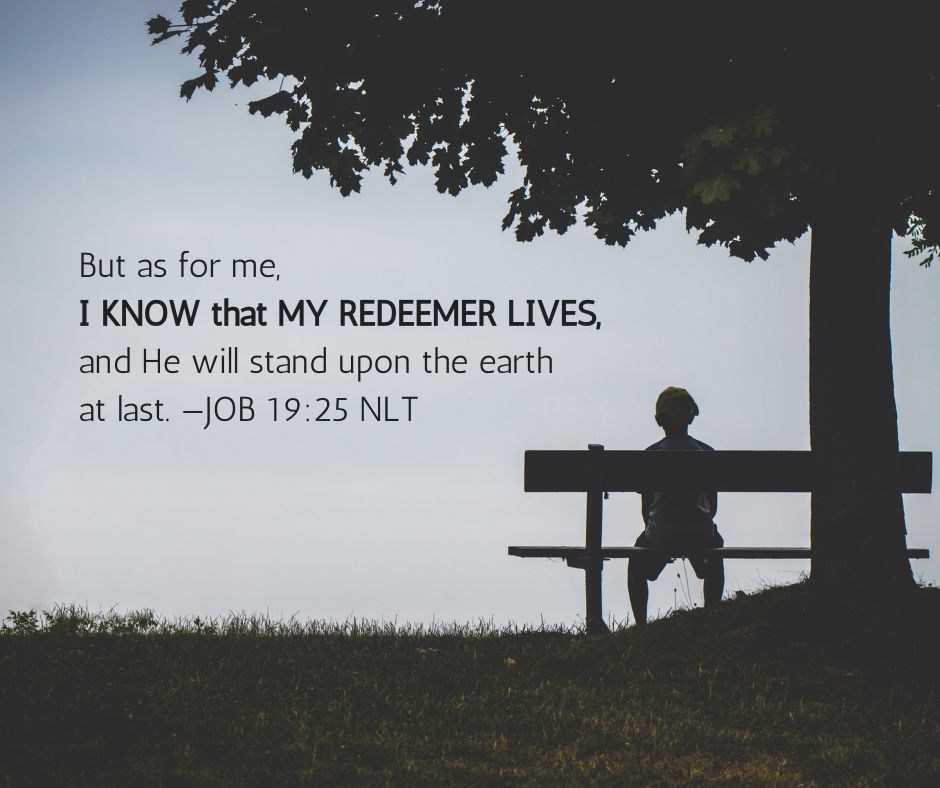
1. I KNOW MY REDEEMER LIVES (Job 19:25).
The word Job used for “redeemer” is a word that used in the OT to describe a “kinsman-redeemer.” A person with both the rights and responsibilities of redeeming and vindicating a family member.
G. Campbell Morgan wrote, “[The Kinsman-Redeemer] stood for another to defend his cause, to avenge wrongs done to him, and so to acquit him of all charges laid against him.”
Author Steven Lawson described the kinsman-redeemer as “…a vindicator of one unjustly wronged. He was a defender of the oppressed. A champion of the suffering. An advocate of one unjustly accused. If you were ever wronged, a redeemer would come and stand beside you as your champion and advocate.”
In Job 19:25 a struggling, suffering man named Job, who had experienced loss on a catastrophic level, applied the concept to God, and was convinced of these three truths:
- God was His Redeemer — His vindicator, defender and champion.
- His Redeemer was alive.
- Because His Redeemer was alive, He could also bring life to Job, even in the aftermath of catastrophic loss.
I love the fact that the NLT translates verse 25, “But as for me, I know…” In other words, “I may be surrounded by doubters, haters, critics and naysayers, but I’m thoroughly convinced of this reality… I know my Redeemer lives…”
There’s an old hymn written in 1775 by Samuel Medley. My favorite version of the hymn is by Mark Heard and Kate Miner covered on an album titled, At The Foot of the Cross, released back in 1991. Every time I read Job 19:25-27, I think of this song.
I know that my Redeemer lives;
What comfort this sweet sentence gives,
He lives, he lives, who once was dead,
He lives – my ever living head.
He lives to silence all my fears,
He lives to wipe away my tears,
He lives to calm my troubled heart,
He lives, all blessings to impart,
He lives, all blessings to impart.
And he lives to grant me daily breath,
He lives, and I shall conquer death,
He lives, and while I live I’ll sing,
He lives, my prophet, priest and king.
He lives triumphant from the grave,
He lives, eternally to save,
And what joy this blessed assurance gives,
I know that my redeemer lives,
I know that my redeemer lives.
—Lyrics by Samuel Medley, 1775
The first thing I know is that MY REDEEMER LIVES.
2. I KNOW MY REDEEMER WILL SHOW UP — “…He will stand upon the earth at last…” (JOB 19:25).
Somehow standing in the aftermath of more loss than is possible to understand, reeling from the apparent silence of God, and, surrounded by so-called “friends” who had become the most severe and hurtful of critics, Job was convinced that God — His Redeemer — would eventually show up, and with His arrival would come Job’s redemption and vindication.
While his critics may hurl their judgements and assessments at what Job had done, could have done, should have done; his critics would not get the last word. God would. The author of the story will eventually take the stage, and when the author walks on to the stage, any and all competing voices will be silenced.
Doubters, haters, critics and naysayers
will not write the final word in your story!
Your Redeemer, Vindicator, Defender and Champion
always gets the final word!
I know that MY REDEEMER will show up!
He will “stand upon the earth at last…”
The phrase “…He will stand upon the earth…” can also be translated, “He will stand on the dust.” Dust is a picture of loss, fragility and failure. Think of Queen’s, “Another one bites the dust…”
Job was thoroughly convinced that God would meet Him in the middle of His loss and failure. I’m convinced of the same. God will meet me in the middle of my mess. This is part of what sustains me when struggling with uncertainty.
I know my REDEEMER lives.
I know He will show up. He’ll meet me in my mess.
3. I KNOW GOD’S PRESENCE CHANGES EVERYTHING (Job 19:26-27).
“And after my skin has been destroyed,
yet in my flesh I will see God;
27 I myself will see him
with my own eyes—I, and not another.
How my heart yearns within me!” —JOB 19:26-27 NIV
Job had felt alone and even abandoned. He had railed about God and even against God, but somehow thru all his questions came this flash of faith. “…yet in my flesh I will see God.”
To “see God” is an indication of proximity and presence. Job realized that He may not physically live to see God show up and come thru, but He was somehow completely convinced that even death and loss could and would not prevent him from seeing and experiencing God.
Job knew that one moment in the presence of God changes everything.
Everything.
It still does.
By the way, Job made the statement in Job 19:25-27 long before Judaism or Christianity had any kind of well-developed theology of resurrection or life after death. Yet, He was convinced that even death couldn’t separate him from his REDEEMER.
Paul, writing from “the other side” of Jesus birth, life, death, burial and resurrection made this incredible statement.
“And I am convinced that nothing can ever separate us from God’s love.
Neither death nor life, neither angels nor demons,
neither our fears for today nor our worries about tomorrow
—not even the powers of hell can separate us from God’s love.
39 No power in the sky above or in the earth below
—indeed, nothing in all creation
will ever be able to separate us from the love of God
that is revealed in Christ Jesus our Lord.”
—ROMANS 8:38-39 NLT
Talk about proximity and presence!
Because of Jesus, nothing can separate us from God’s love! Rob Lacey paraphrased Paul’s words like this:
“I’m totally sold on the fact that, at the end of the day, there’s nothing that can cut our ties with God’s love that Jesus proved.
Nothing — not life, nor death; angels nor demons;
the now nor the future; nor any of ‘the powers that be’;
not distance nor anything else in the cosmos — zilch, a big fat 0.
Nothing can cut off God’s love supply to us. Nothing. End of story.”
—Rob Lacey, The Word On The Street, p 367
I may not know what 2023 holds, by I know who is holding me. I know that He has promised that He will never leave me or forsake me (Deut 31:6, 8; Josh 1:5, 9; Heb 13:5).
Looking back over the year that has been,
standing on the precipice of the year that is yet to be,
both past and present filled with uncertainty,
these three things I know:
—I know my REDEEMER lives.
—I know He will show up. He’ll meet me in the middle of my mess.
—I know His presence changes everything.
Somehow, that’s enough.